

We provide Flux-2D online (apkid: com.analytical.methods.flux.2d) in order to run this application in our online Android emulator.
Description:
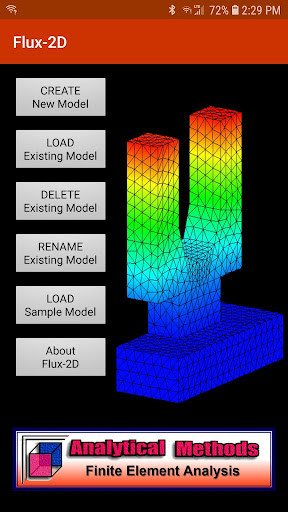
Run this app named Flux-2D using MyAndroid.
You can do it using our Android online emulator.
The application performs steady-state and transient analyses of 2D plate structures using the Finite Element Method.
It is general purpose in scope and easy to use.
Solution of small to moderate size problems can be obtained.
For steady-state analyses, temperatures throughout the structure are computed.
For transient analyses, temperatures versus time are obtained.
Temperatures can be plotted or contoured.
Flux-2D was developed for use by design engineers, thermal, structural, and mechanical engineering students, and experienced professionals who desire rapid and accurate solutions to a wide variety of problems.
The modeling and analysis process consists of the following steps:
1: Name the model
2: Select system of units
3: Define coordinate system (optional):
- Cartesian or polar
- x-y coordinates of origin
4: Add materials:
- material name
- thermal conductivity k
- weight density rho
- specific heat
5: Add nodes:
- x and y coordinates
6: Add elements:
- I-J-K corner nodes
- material ID
- thickness
7: Add boundary conditions to nodes:
- node for application of boundary condition
- fixed temperature
- initial temperature (transient analysis)
- heat generation
8: Add mass to nodes (optional):
- node for application of weight
- mass magnitude
- specific heat associated with mass
9: Solve the system of linear equations:
- temperatures for steady-state
- time varying temperatures for transient
10: View results
- view model text file
- view results text file
- share files
- plot temperatures or heat fluxes
- chart temperatures vs.
time
- animate temperatures
It is general purpose in scope and easy to use.
Solution of small to moderate size problems can be obtained.
For steady-state analyses, temperatures throughout the structure are computed.
For transient analyses, temperatures versus time are obtained.
Temperatures can be plotted or contoured.
Flux-2D was developed for use by design engineers, thermal, structural, and mechanical engineering students, and experienced professionals who desire rapid and accurate solutions to a wide variety of problems.
The modeling and analysis process consists of the following steps:
1: Name the model
2: Select system of units
3: Define coordinate system (optional):
- Cartesian or polar
- x-y coordinates of origin
4: Add materials:
- material name
- thermal conductivity k
- weight density rho
- specific heat
5: Add nodes:
- x and y coordinates
6: Add elements:
- I-J-K corner nodes
- material ID
- thickness
7: Add boundary conditions to nodes:
- node for application of boundary condition
- fixed temperature
- initial temperature (transient analysis)
- heat generation
8: Add mass to nodes (optional):
- node for application of weight
- mass magnitude
- specific heat associated with mass
9: Solve the system of linear equations:
- temperatures for steady-state
- time varying temperatures for transient
10: View results
- view model text file
- view results text file
- share files
- plot temperatures or heat fluxes
- chart temperatures vs.
time
- animate temperatures
MyAndroid is not a downloader online for Flux-2D. It only allows to test online Flux-2D with apkid com.analytical.methods.flux.2d. MyAndroid provides the official Google Play Store to run Flux-2D online.
